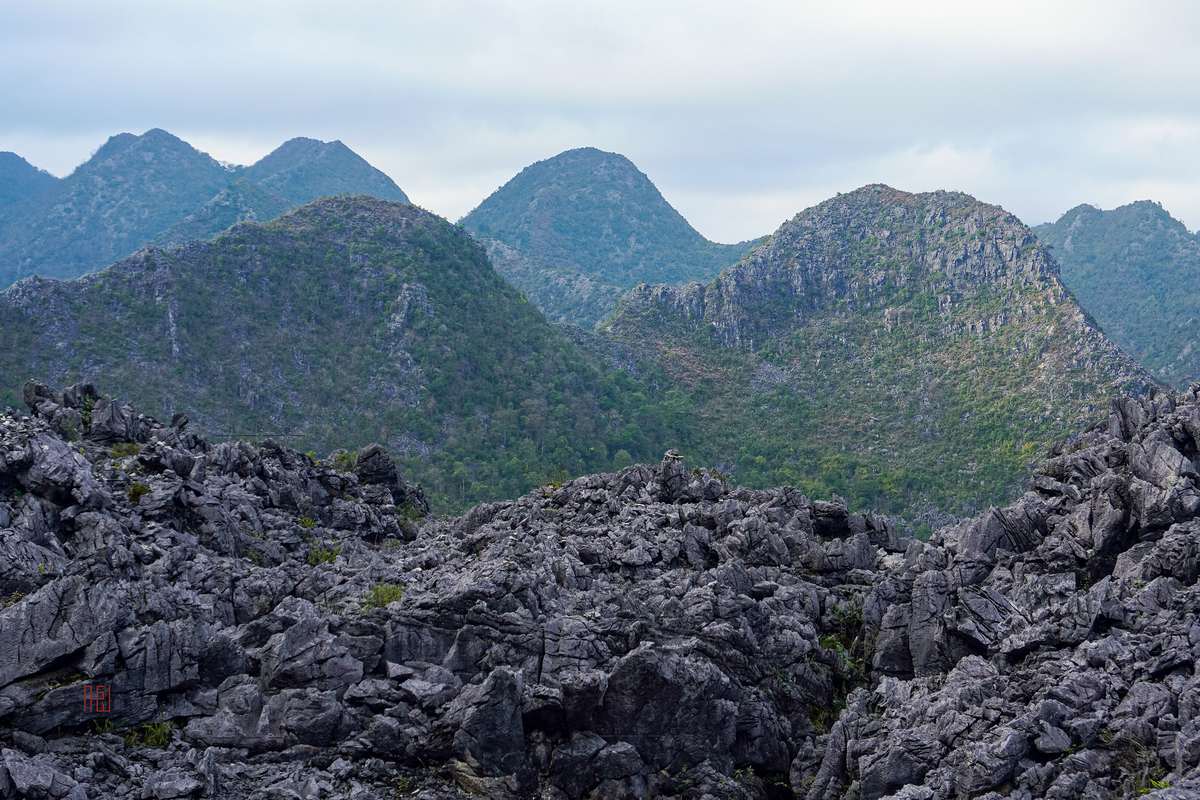
Short version: around 24 km between Dong Van and Meo Vac, topping out near 1,500 m, with the Nho Que river in a gorge several hundred metres below. It is the reason most people come to Ha Giang, and it deserves a whole morning rather than a photo stop.
The road that took six years
The pass is part of what Vietnam calls the Happiness Road — a 200 km route from Ha Giang City up to Dong Van and Meo Vac, begun in 1959. Before it, the far north was reached on foot. The Ma Pi Leng section was the hard part: a shelf cut into a near-vertical limestone face by volunteers from a number of ethnic groups, working with hand tools and rope, over years rather than months.
It is worth knowing that as you ride it. The road is not dramatic by accident. Every metre of it was somebody's idea of what was worth doing.
What you are looking at
Below the pass, the Nho Que river runs through Tu San canyon — the deepest in Southeast Asia, with walls of 700 to 800 metres over a stretch of not much more than a kilometre and a half. From the road it reads as a green thread at the bottom of something too large to photograph. From a boat on the water, looking up, it reads as something else entirely.
The boat trip is the single thing we would not skip. It takes about an hour, the ticket is included on our tours, and the change of scale from the top of the pass to the surface of the river is the part people describe when they get home.
Riding it
The surface is sealed and generally good. What makes it demanding is everything else.
- The drop. There is no barrier for long stretches. If heights unsettle you, ride the inside line and keep your eyes where you want the bike to go.
- The weather. Cloud sits on the pass. You can leave Dong Van in sunshine and be in twenty-metre visibility twenty minutes later, at ten degrees colder.
- Other traffic. Trucks take the whole road through blind bends because they have to. Assume something is coming.
- The stopping. Everyone stops, and not always where there is room. Pull properly off the road, and look before you open a door or step backwards for a photograph.
Where to stop
There are several pull-ins along the pass and a viewpoint near the middle with a monument and a stall selling coffee. It is busy in the middle of the day and worth the stop anyway. The quieter photographs come from the smaller pull-ins either side of it, and from the descent toward Meo Vac, where the road unwinds below you in a way the top of the pass never shows.
If the cloud is down when you arrive, wait twenty minutes. It moves.
When to ride it
Morning, in almost every season. The light is behind you heading east from Dong Van, the cloud tends to lift as the day warms, and the coach parties arrive later. On our tours the pass falls on the second day, which is the long one, and we start it early for exactly that reason.